What difficulties do autistic students face in Australia?

For now, all of the conditions associated with this neurological spectrum disorder are placed under the umbrella term Autistic Spectrum Disorders (ASD), but many people, including professionals and therapists, still use a variety of names and subcategories when diagnosing and talking about autism and its symptoms.

  1. But doesn’t early intervention help with autism?
  2. There are professionals and varied solutions to help autistic individuals, isn’t it?

While early intervention is vital for improving quality of life, there are still difficulties that autistic children and adults face in Australia on most days. What difficulties do autistic students face in Australia is an important question for parents, educators and professionals seeking to better understand the challenges students may experience in learning, communication, social interaction and daily school life.


Problems faced by autistic students

If your child presents signs of Autism, claim your 20 minutes FREE chat valued at $125 with our expert

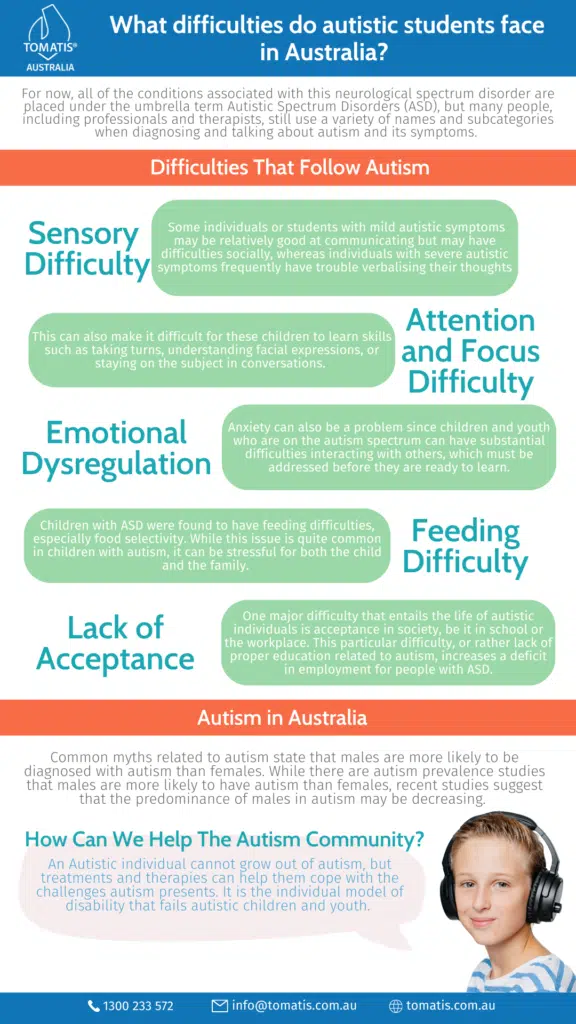
Difficulties That Follow Autism

Autistic students may experience different challenges that affect their learning, communication, social interaction and daily routines. Understanding what difficulties do autistic students face in Australia can help parents, teachers and professionals identify areas where additional support may be beneficial.

1. Sensory Difficulty

Autistic children, youth and even adults frequently have difficulties with sensory processing, which may range in severity and may significantly affect learning and daily living. Some individuals or students with mild autistic symptoms may be relatively good at communicating but may have difficulties socially, whereas individuals with more severe autistic symptoms frequently have trouble verbalising their thoughts. Sensory processing challenges are among what difficulties do autistic students face in Australia, particularly in busy classroom environments where noise, lights and other sensory stimuli can become overwhelming.

2. Attention and Focus Difficulty

Difficulties with attention may make communication and language skills more difficult for children with ASD. This particular attention and focus issue may also make it difficult for these children to learn skills such as taking turns, understanding facial expressions, or staying on the subject in conversations. Children with ASD may find it difficult to transfer what they learn in one environment, such as during therapy or school, to others, including at home.It can also be linked to difficulties processing auditory information, which may impact their level of comprehension. “How can you pay attention if you don’t understand what people say to you?” says Francoise Nicoloff, a neurodiverse expert. Attention and focus are another important consideration when understanding what difficulties do autistic students face in Australia.

3. Emotional Dysregulation – Anxiety and Depression

Anxiety can also be a problem since children and youth who are on the autism spectrum can have substantial difficulties interacting with others, which may need to be addressed before they are ready to learn. People with level 2 autism can also have difficulty functioning day-to-day because of challenges in dealing with changes.Emotional dysregulation, anxiety and difficulties adapting to changes can therefore be important factors when considering what difficulties do autistic students face in Australia, particularly within school and social settings.

4. Feeding Difficulty

According to a survey, children with ASD were found to have feeding difficulties, especially food selectivity. While this issue is quite common in children with autism, it can be stressful for both the child and the family.Although feeding difficulties may not directly affect classroom learning, they can influence a student’s daily routine, comfort and wellbeing. This is another aspect to consider when looking at what difficulties do autistic students face in Australia.

5. Lack of Acceptance

One major difficulty that affects the lives of autistic individuals is acceptance in society, whether at school or in the workplace. This particular difficulty, or rather the lack of proper education and awareness related to autism, can create barriers to employment for people with ASD.Understand that the absence of wider acceptance is not because an autistic person is unable to work, but may instead result from limited understanding of autism among employers and the wider community. Improving awareness and creating inclusive environments can help address some of what difficulties do autistic students face in Australia as they progress through education and into adulthood.

Autistic Girl

If your child presents signs of Autism, claim your 20 minutes FREE chat valued at $125 with our expert

Difficulties That Follow Autism

Autistic students may experience different challenges that affect their learning, communication, social interaction and daily routines. Understanding what difficulties do autistic students face in Australia can help parents, teachers and professionals identify areas where additional support may be beneficial.

1. Sensory Difficulty

Autistic children, youth and even adults frequently have difficulties with sensory processing, which may range in severity and may significantly affect learning and daily living. Some individuals or students with mild autistic symptoms may be relatively good at communicating but may have difficulties socially, whereas individuals with more severe autistic symptoms frequently have trouble verbalising their thoughts. Sensory processing challenges are among what difficulties do autistic students face in Australia, particularly in busy classroom environments where noise, lights and other sensory stimuli can become overwhelming.

2. Attention and Focus Difficulty

Difficulties with attention may make communication and language skills more difficult for children with ASD. This particular attention and focus issue may also make it difficult for these children to learn skills such as taking turns, understanding facial expressions, or staying on the subject in conversations. Children with ASD may find it difficult to transfer what they learn in one environment, such as during therapy or school, to others, including at home.It can also be linked to difficulties processing auditory information, which may impact their level of comprehension. “How can you pay attention if you don’t understand what people say to you?” says Francoise Nicoloff, a neurodiverse expert. Attention and focus are another important consideration when understanding what difficulties do autistic students face in Australia.

3. Emotional Dysregulation – Anxiety and Depression

Anxiety can also be a problem since children and youth who are on the autism spectrum can have substantial difficulties interacting with others, which may need to be addressed before they are ready to learn. People with level 2 autism can also have difficulty functioning day-to-day because of challenges in dealing with changes.Emotional dysregulation, anxiety and difficulties adapting to changes can therefore be important factors when considering what difficulties do autistic students face in Australia, particularly within school and social settings.

4. Feeding Difficulty

According to a survey, children with ASD were found to have feeding difficulties, especially food selectivity. While this issue is quite common in children with autism, it can be stressful for both the child and the family.Although feeding difficulties may not directly affect classroom learning, they can influence a student’s daily routine, comfort and wellbeing. This is another aspect to consider when looking at what difficulties do autistic students face in Australia.

5. Lack of Acceptance

One major difficulty that affects the lives of autistic individuals is acceptance in society, whether at school or in the workplace. This particular difficulty, or rather the lack of proper education and awareness related to autism, can create barriers to employment for people with ASD.Understand that the absence of wider acceptance is not because an autistic person is unable to work, but may instead result from limited understanding of autism among employers and the wider community. Improving awareness and creating inclusive environments can help address some of what difficulties do autistic students face in Australia as they progress through education and into adulthood.

Autistic Child

Isn’t The Myth – An Autistic person Has Savant Skills – Correct to An Extent and Advantage to An Autistic?

Many people with ASD may come across sensory problems, repetitive patterns of behaviours, delayed or absent language development, and poor motor coordination, among others. But this neurodevelopmental disorder also gives rise to certain myths and misconceptions. One of the myths that say – an autistic person is a savant might depict that autism does not walk with difficulties. At the same time, there has been only a small percentage of autistic people who might have excellent skills; not all autistic people come with a gift. 

Also, even if all individuals with autism face varied difficulties, because of which they might feel lonely at times, it is important to understand that all autistic are unique in their own way. 

Bear in mind that children with autism spectrum disorder (ASD) develop at different rates, and they do not necessarily develop skills in the same order as children who are developing normally. And therefore, the ability of individuals with ASD to learn, think, and solve problems may vary from gifted to highly challenged. 

What difficulties do autistic students face in Australia?

If your child presents signs of Autism, claim your 20 minutes FREE chat valued at $125 with our expert

Françoise Nicoloff

Official Representative of Tomatis Developpement SA in Australia, Asia and South Pacific, Director of the Australian Tomatis® Method, Registered Psychologist, Certified Tomatis® Consultant Senior, Tomatis® International Trainer and Speaker, Co-author of the Listening Journey Series, 40 Years of Experience, Neurodiversity Speaker

Leave a Reply

Your email address will not be published. Required fields are marked *

Fill out this field
Fill out this field
Please enter a valid email address.
You need to agree with the terms to proceed